
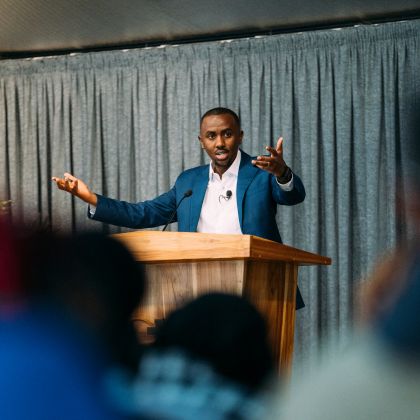
For much of his life, Joshua Lemayan did not plan to be a pastor. He trained as a computer scientist and mathematician. Lemayan gradually discovered that God was redirecting his life toward the church. A decade later, he serves as an associate pastor at Emmanuel Baptist Church in Nairobi, Kenya, laboring in a city where the gospel is widely claimed, often misunderstood, and desperately needed.
“At Emmanuel Baptist Church, we hope the work we do is what churches have done for the last 2,000 years: we preach the gospel, and we make disciples,” Lemayan said. “We’ve seen people come to Christ, and we’ve seen many Christians continue to grow and mature in their faith. We’re also engaged in planting other churches, as well as equipping churches in our city and region with resources for building healthy churches.”
That emphasis on equipping reflects a deep concern. Across Africa, most pastors lack formal theological training. Southern Seminary, from thousands of miles away, serves as part of the answer to that need.
“Nine out of ten pastors in Africa do not have access to formal theological education,” Lemayan said. “That often means the pastor standing behind a pulpit in many congregations does so without much equipping in how to open the Bible, interpret it, and preach it. One result is that false teaching often meets very low immunity among pastors and congregations.”
In Nairobi, this shortage of training intersects with another challenge. Most people identify as Christian, but many do not understand the gospel.
“In the last census, 85% of people identified as Christian,” Lemayan said. “But many people mean ‘Christian’ as opposed to Muslim, Hindu, Buddhist, and so on. They may attend church occasionally or have a Christian name. But many don’t actually have a personal relationship with the Lord.”
That reality shapes how he preaches and pastors. His ministry requires patience, clarity, and careful teaching.
“You’re often preaching to inoculated ears,” he said. “Ears that dismiss what you’re saying because they assume they already believe it.”
Prosperity teaching intensifies that difficulty. Many people approach God through a framework shaped by traditional religion, assuming blessing follows obedience.
“Part of why prosperity teaching spreads so easily in our context is that many Africans have an underlying model that says: if I appease God, my life will go well,” Lemayan said. “What they’re missing is that the gospel often includes suffering and persecution.”
Alongside local ministry, Lemayan pursued theological education through Southern Seminary’s online programs. For him, seminary did not replace ministry. It strengthened it.
“I’m thankful the Lord has ordered my engagement with formal theological education not to qualify me for ministry, but to further equip me to continue the ministry I’m already doing,” he said. “It has expanded my toolbox tools I can access and apply in ministry.”
Training in Greek, biblical counseling, and Old Testament theology sharpened both his preaching and his shepherding. Southern’s church-centered approach helped him see that theological education serves the whole work of ministry.
“Greek and Hebrew have helped me get deeper into God’s word, something I was already doing, now augmented,” he said. “Classes in biblical counseling helped me think more clearly about what I’m trying to accomplish when shepherding.”
Southern Online proved especially significant because it brought theological education to his context instead of removing him from it. At the same time, it allowed him to remain fully present with his church.
“I can keep preaching, counseling, and shepherding alongside our elders at Emmanuel Baptist Church while accessing high-quality education,” Lemayan said. “That feels like a miracle a great blessing.”
Lemayan now sees Southern’s online model as strategically vital for Africa’s future. It equips pastors without pulling them away from their people.
“My hope is that having been trained, I can help train others,” he said. “I’m gaining experience in my context while accessing quality theological education, and that combination can help equip pastors who need both.”
The urgency only grows. Kenya’s average age is 19, and millions of young people will shape the church in the coming decades.
“What you don’t have rising proportionately are well-trained pastors who love God, love his flock, and can think and write clearly about emerging issues in their context,” Lemayan said. “We need theological education at the very time when theological education is lacking.”
Many predict that by 2050, Africa will house the world’s largest Christian population. Lemayan believes that makes institutions like Southern Seminary even more important.
“The question is: what kind of Christianity will that population have?” he said. “If current trends continue, it will be heavily characterized by prosperity gospel and word-of-faith teaching. That’s a threat not only to Christianity in Africa, but to Christianity globally.”
For Lemayan, the answer lies in healthier churches led by pastors formed theologically, pastorally, and spiritually. Southern Seminary, he argues, strengthens that work by training ministers who remain rooted in their own contexts and labor among their own people.