
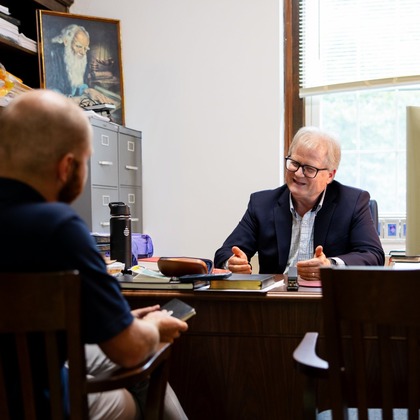
Southern Seminary often describes its approach to theological education with a simple phrase: “study with the authors.” The phrase reflects the seminary’s commitment to giving students direct access to its faculty, both on campus in Louisville and in its online programs.
Paul Akin, Provost of Southern Seminary, said the phrase points to something more valuable than the books faculty members have written.
“When you study here, you’re learning from men who are published authors, respected in the church, and serious scholars in their fields,” Akin said. “The real blessing of studying with our faculty is sitting in the room and pushing on the ideas behind the books: asking why they argued it that way, where they’ve changed their minds, what they left out, and how this plays out in a local church or on the mission field.”
Akin said Southern intentionally builds a faculty that loves teaching as much as research because of the seminary’s mission.
“We’re training pastors, missionaries, and teachers, not just producing scholarship,” he said. “Research matters, and it makes our faculty better teachers, but a professor who sees students as an interruption to his real work won’t form them well. The classroom, the conversation after church, and the lunch in the dining hall are where much of the formation and transformation actually take place.”
Akin pointed to several faculty members who embody that vision. Robert L. Plummer’s work in Greek and the New Testament is read around the world, yet he still stays after class to keep talking with students. Ayman S. Ibrahim invites students into his home and builds relationships with them inside and outside the classroom. J. Keith McKinley takes students on mission trips around the world, helping them understand ministry in a Great Commission context. Thomas R. Schreiner regularly talks with students before and after services at Clifton Baptist Church.
That same commitment shapes Southern’s online programs, where courses are taught by the same full-time faculty who teach in Louisville. Brian Renshaw, Vice President of Enrollment Strategy and Global Campus, said that consistency matters more as theological education increasingly moves online.
“It’s more important than ever, especially in online learning, that the professors teaching the courses are the same ones you’d learn from on campus,” Renshaw said. “At Southern, we rarely use adjuncts. No matter the format, you’re learning directly from our faculty.”
Renshaw said that commitment distinguishes Southern from many other online programs.
“Many other online programs rely on adjuncts for interaction, even if full-time faculty appear in videos,” he said. “This is one of the key differences that sets us apart.”
Online students meet their professors through LiveSync sessions, which are live video meetings designed for real interaction rather than recorded content alone. Renshaw said these sessions put students in direct conversation with the faculty member who built the course.
“Our professors teach every course,” Renshaw said. “Students can join five to six LiveSync sessions with their professor, where they can ask questions and engage directly.”
Online students can also email their professors or meet them over coffee when visiting campus. Southern brings nearly 20 years of online experience to that work, building on earlier correspondence programs, and a dedicated online learning team helps faculty with course design so professors can focus on teaching. Renshaw credited that history, along with the leadership of President R. Albert Mohler Jr. and the expertise of long-serving faculty, for the program’s strength today.
For Akin, the vision behind “study with the authors” reaches far beyond Louisville. He said the conversations students have with faculty today will shape ministry around the world.
“What a student wrestles through with a professor in Louisville ends up being preached in a church in Kentucky or taught to pastors in Kenya,” Akin said. “When you study with the authors, you aren’t just learning content. You are being shaped by people who have given their lives to the church and to the Great Commission, and you’re joining a conversation that is much bigger than any one book.”