
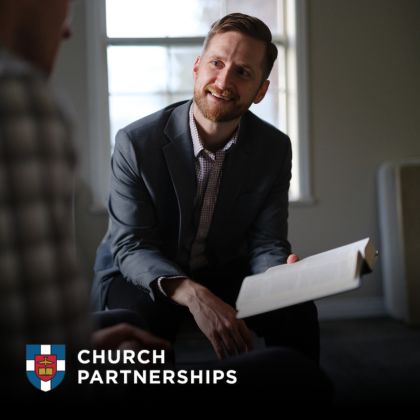
Southern Seminary has announced a new Church Partnerships initiative designed to formalize its longstanding commitment to serving local churches.
The Church Partnerships program acknowledges that across the country, churches are already training future pastors, ministry leaders, and staff through internships, apprenticeships, residency programs, and structured theological instruction. Rather than requiring students to duplicate that work, Southern seeks to come alongside churches and affirm their formation efforts by creating accredited academic pathways that build on what churches are already doing.
Paul Akin, Provost at Southern Seminary, said that the Church Partnerships initiative helps fulfill Southern’s mission of serving churches.
“We exist to serve churches,” Akin said. “Therefore, theological education must be rooted in the local church. Working together ensures that seminary training remains pastorally grounded and missionally focused. Engaging and collaborating with churches to train pastors, missionaries, and churches leaders in this way is not an expansion of our mission—it is the fulfillment of our mission.”
Three key pathways are available for students to receive seminary credits in their local church: the Ministry Apprenticeship Program, Contextualized Leadership Development, and Church-Based Seminary Courses. These options allow ministry training, local classes, or seminary courses taught on-site to lead to academic credit without students leaving the life of their church.
Contextualized Leadership Development allows churches to offer structured classes in their local church through a qualified instructor, enabling participants to receive seminary credit for that instruction without paying tuition. This pathway is designed to recognize the teaching and discipleship already happening in the local church while giving students a clear way to apply that learning toward formal theological education. For those who are not yet enrolled at Southern, an abbreviated application process allows the credit to be recorded by the seminary from the start, so it can apply directly toward a Southern degree if the student later enrolls in a degree program.
Brian Renshaw, Vice President for Enrollment Strategy and Global Campus, said the initiative reflects a church-first philosophy that motivates the seminary.
“I’m excited to continue Southern’s focus on equipping local churches and ministry networks by formalizing our Church Partnerships,” Renshaw said. “We want to provide clear, church-first pathways that come alongside the training already happening in local congregations, helping prepare the next generation of leaders with theological depth and practical formation.”
Renshaw emphasized that Southern’s vision is shaped by a conviction that discipleship and formation already occurring in churches should be recognized and integrated into seminary education. He noted that Southern has revamped its Ministry Apprenticeship Program (MAP) to better align with what churches are already doing, while remaining flexible to the unique needs of individual churches.
“Our vision recognizes that discipleship and formation are already happening in churches, and we want that work to become an integrated part of a trusted Southern Seminary education, strengthened by Southern’s trusted faculty,” Renshaw said. “As part of that, students can now earn supervised ministry credit in MAP as elective credit or core credit, depending on the training and supervision taking place at the local church level.”
Blake Burris, Director of Alumni and Church Engagement, will serve as a primary point of contact for churches exploring accredited pathways connected to their existing training. Burris previously served as Director of Southern Seminary Admissions for the past three years.
“I’m excited because I get to spend my time listening to churches and helping them build on what they are already doing,” Burris said. “We want these partnerships to serve the church’s leadership training and formation goals, not force a one-size-fits-all model.”
“One of the keys is being church first, to think through ways to partner with churches that come alongside what they’re already doing,” Renshaw said. “By creating this role, we are committing resources to come alongside churches to strengthen what they’re doing so students do not have to duplicate training and learning that is already happening in the local church.”
The Church Partnerships program underscores Southern Seminary’s conviction that the health of the church and the training of its leaders are inseparable. By recognizing and building on existing ministry training in congregations, the seminary says it hopes to support churches while equipping students with both theological depth and hands-on experience for faithful service.
For more information on Church Partnerships and to begin the process of church-first theological education, visit sbts.edu/academics/church-partnerships.