
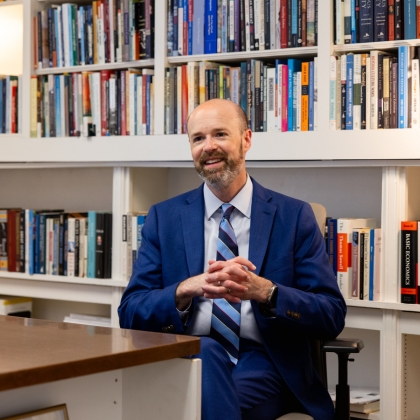
Andrew Walker did not set out to become a dean. He set out to argue that theology does not stay between the ears.
That conviction shaped a career that took him from the Family Foundation of Kentucky to the Heritage Foundation to the Ethics and Religious Liberty Commission, three organizations built to press Christian conviction into public life. That same conviction now shapes his new role as Dean of the School of Theology at Southern Seminary.
“If what Christianity asserts is true, it’s true regardless of whether or not people who are Christians want to accept it as true,” Walker said. “It is just truth. And it means that society needs to conform itself to what is true if society is going to thrive and prosper.”
While he still writes and teaches on the need for public engagement in a variety of contexts, Walker feels most at home when training pastors and ministry leaders.
“One of the challenges of working in think tanks is that you are kind of writing for everyone and no one,” he said. “You don’t have a natural constituency. You don’t really know where these ideas are going and how you can measure them, how you can measure their impact.”
Teaching at Southern, and the local church behind it, closed that gap for Walker.
“When I look out to a classroom, I’m thinking that I’m not just teaching one potential pastor,” Walker said. “If a student takes what they learned in my class on abortion and then teaches that to their congregation, let’s say it’s a church of a hundred people, this biblical idea just had a hundredfold increase. There’s a force multiplier effect.”
Walker sees that multiplier effect extending well past any one classroom or congregation. As he sees it, his role at Southern carries a stewardship for the health of the wider Southern Baptist Convention, and by extension, evangelicalism as a whole.
“When you look at the SBC nationally within broader evangelicalism, it’s a very influential institution,” Walker said. “As goes the SBC, as goes Protestantism and as goes evangelicalism. Therefore, we need places like Southern Seminary locked down doctrinally, morally, ethically.”
For Walker, that doctrinal health, which reveals itself in healthy churches, is inseparable from ethics.
“My own conviction is that theology should wag the tail of ethics. Theology should be the dog. Ethics is the tail. Oftentimes it’s ethics that ends up wagging the dog. The best way to do what I think God has called me to do is to train pastors and leaders for the church, particularly in a Southern Baptist context, to live out the moral implications of the gospel.”
That vision of ministry shapes how he talks about the students he teaches.
“There is a starry-eyed excitement about ministry that even when you’re doing something that you love, things can, in certain seasons, become a job,” he said. “Seeing students and their excitement about ministry guards against me treating this job as just perfunctory and routine.”
Walker is emphatic that teaching is not merely the transfer of information. He values getting to spend time with students whether on campus or online.
“Students should understand the delight that their professors get in building relationships with them, that it’s not just the transmission of knowledge. We are embodied, incarnate persons. Something mysterious and something wonderful happens when you have embodied persons communicating and trying to live out these beautiful truths that accord with the gospel.”
He carries that same seriousness into his view of the institution he now leads. Walker has seen first-hand how seminaries must always be on guard against false doctrines and ideologies. He wants students to rest assured that Southern Seminary’s faculty remains committed to biblical Christianity.
“You’re never more than a generation, or quite frankly, one hire away, from infiltrating the institution with theological drift. I do not want students to come here and have to remotely think that they’re going to have their faith shipwrecked or their ministry calling devalued.”
That conviction extends to how he speaks of his colleagues.
“I think this is the premier theology faculty in evangelicalism,” Walker said. “That coincides with a bunch of individuals who are churchmen, who are husbands and fathers.”
For Walker, that combination is the point.
“We’re not here to be cute with the Bible. We take it as God’s revealed word, and that’s a sacred trust. I think every faculty member here lives with the mentality that that is a sacred trust.”
Walker’s admiration for his predecessor reflects the same values.
“Dr. York is one of the most secure, happy, stable leaders you could ever want to work for,” he said. “Institutions require emotionally healthy leaders, and Dr. York is an exceptionally, emotionally healthy person.”
Outside the classroom, Walker serves on the preaching team at Highview Baptist Church and teaches a weekly community group. In all his pursuits, Walker’s core convictions remain the same: theology is meant to be lived, taught, and handed to the next generation of pastors, whether from a pulpit, a think tank, or now, a dean’s office.