
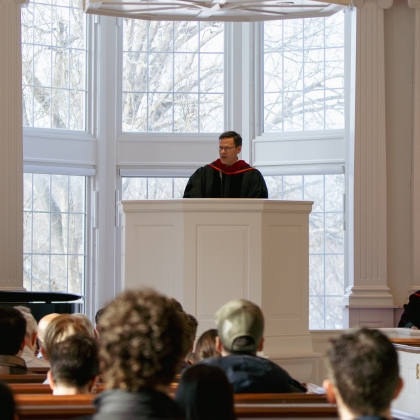
Shawn Wright, Professor of Church History at The Southern Baptist Theological Seminary, delivered the Faculty Address titled “The Reformation, Baptists, and Biblical Retrieval Theology” to colleagues and students on February 4, 2026.
President R. Albert Mohler Jr. opened the address by highlighting the historical weight of the occasion. “The Faculty Address offers a timely and substantial matter that informs colleagues both within and beyond one’s own discipline, and to present work that is itself a contribution to scholarship,” Mohler said. “This is one of the most urgent considerations of the hour.”
What Is Theological Retrieval?
“As long as there have been Christians, believers have cared about what their predecessors believed,” Wright said. “So-called retrieval theology does more than that. Seeing dangers all around, it looks back to the past and allows people and ideas from long ago to set the agenda for the church’s beliefs and practices today.”
Wright framed his address in light of growing evangelical interest in aggressive retrieval, which has tempted believers to abandon Baptist or even Protestant convictions.
“The biblically revealed gospel sits in judgment over aggressive retrieval theology that would lead people away from Reformation Protestantism,” Wright said. “Baptists, as the fullest flowering of the Protestant Reformation, have a unique way of guarding the biblical gospel and protecting our churches from aggressive retrieval.”
He summarized retrieval theology as a methodological orientation, especially related to the doctrine of God and biblical hermeneutics. “The desire is to go back to what is perceived as a better way of doing theology,” Wright said. “Yet, in seeking renewal through retrieval, some evangelicals have ended up leaving evangelicalism altogether. In the process of trying to protect the gospel, they have come to conclusions that are, in fact, antithetical to the biblical gospel.”
Ultimately, Wright argued that Scripture must judge retrieval theology.
Caution one: be humble and wise, for old is good . . . unless it is bad.
“Retrieval theology rightly desires to listen to the past,” Wright said. “That is a sign of humility—one of the key virtues we should all pursue.” He spoke of learning from figures such as Athanasius, John Owen, Polycarp, and Monica, emphasizing humility before the Christian tradition.
“But humility must have guardrails,” Wright said. “Whom should I follow, and how much?”
He pointed to Arius as an example of someone from church history not to follow.
“We must not assume that because something is old, it is therefore good,” Wright said. “We must avoid an over-realized eschatology about the past. Even in the apostles’ lifetimes, churches were deeply flawed. We should not assume that things were always wonderful in church history.”
Caution two: do not overreact in a time of crisis.
“Many advocates of retrieval believe we are in a unique theological crisis, often traced back to the Enlightenment,” Wright said. “In biblical interpretation, for example, some argue that Enlightenment thinking led to higher criticism, which undermined confidence in Scripture. As a corrective, they propose recovering the fourfold sense of Scripture from the early and Medieval church.”
Wright noted that Reformers such as William Tyndale and John Calvin emphasized the literal sense of Scripture and criticized excessive allegory long before modernity.
“We should not overreact by adopting interpretive or theological methods simply because we are anxious about our moment,” Wright said. “Christ told us we would have trouble in this world. Crisis is normal for the church.”
Caution three: justification by faith alone and assurance of salvation remain central.
“There is value in thinking carefully about God’s being,” Wright said. “But when Thomas Aquinas becomes the primary guide, we must remember that his theology is a system. His doctrine of God is tied to his sacramental and soteriological views.”
For Wright, Aquinas’s doctrine of salvation does not align with the gospel.
“At the heart of the Reformation was the question, how can a sinner be right with a holy God?” Wright said. “Martin Luther wrestled deeply with this and found peace only in the doctrine that we are justified by faith alone in Christ alone. Believers could embrace the doctrines of the Reformation and say, ‘I know whom I have believed.’ This assurance was not arrogance but confidence in Christ’s finished work.”
Caution four: keep the biblical view of the church central.
Wright warned that retrieval theology can speak of “the church” in ways that blur biblical distinctions.
“When tradition is treated as the voice of the church, it can begin to function as an authority alongside Scripture,” Wright said. “The Reformers identified the marks of the true church as the right preaching of the gospel and the right administration of the sacraments. Where the gospel is distorted, the church is in danger, no matter how impressive its historical continuity.”
Caution five: Baptists have always been willing to depart from church tradition.
Wright added that Baptists emphasize a regenerate church, made up of those who profess faith and are baptized as believers.
“The English Baptists arose from Puritan and confessional soil, seeing themselves as heirs of the Reformation,” Wright said. “But they concluded that Scripture taught believer’s baptism and a gathered church of professing believers. In doing so, they broke with a long-standing consensus of Christendom.”
Baptists argued out of conviction that Scripture must have the final say.
Caution six: tradition has no independent authority.
“Protestants rightly value the wisdom of the church through the ages,” Wright said. “We read confessions, creeds, and theologians with gratitude. But tradition must always remain subordinate to Scripture. The Bible alone is the final authority for faith and practice.”
In conclusion, Wright reiterated that the gospel must judge retrieval theology.
“Baptists, as a particular expression of the Reformation, have a distinctive way of guarding the gospel by emphasizing the authority of Scripture, justification by faith alone, regenerate church membership, and the subordinate place of tradition,” Wright said. “May God give us grace to be humble learners from the past, wise judges of tradition, and steadfast defenders of the gospel once for all delivered to the saints.”