
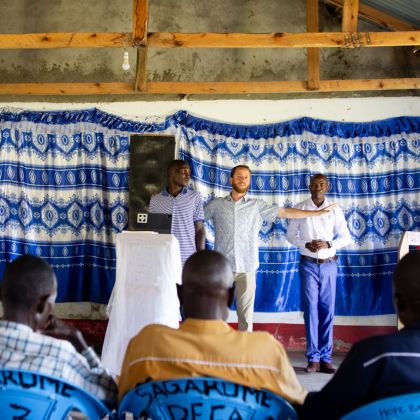
At The Southern Baptist Theological Seminary, missions is not treated as an abstract ideal reserved for future ministry. It is woven directly into student formation, training, and opportunity. For Mark Schisler, that commitment became tangible through a Bevin Center theological education trip to Kenya—an experience that reshaped his vision for ministry and confirmed Southern’s mission-minded identity.
Schisler, an MDiv student at Southern Seminary who also serves as a staff photographer, first learned about the Bevin Center’s global trips while photographing a campus event. As details were shared about international partnerships and theological training abroad, one location stood out.
“As soon as I heard about Kenya and the work of theological education being done there, I knew I wanted to go,” Schisler said.
That instinct reflects a broader emphasis at Southern Seminary, where students are not only taught the importance of the Great Commission but are given concrete pathways to participate in it during their training. Through the Bevin Center for Missions Mobilization, Southern regularly sends students into global ministry contexts alongside experienced professors and pastors.
Schisler joined a team that spent two weeks traveling to three different regions in Kenya, teaching theology in local churches. The focus was not short-term relief work or surface-level programming, but sustained theological instruction aimed at strengthening the local church.
“What stood out most was the humility and hunger of the churches,” Schisler said. “They wanted to understand the Scriptures deeply and apply them to their lives. Even after hours of teaching, they kept asking questions and engaging.”
That hunger exists alongside real challenges. Schisler noted that many Kenyan churches face limited access to sound theological resources and trained leaders, making them vulnerable to syncretistic teaching that blends prosperity theology and animism.
Southern’s approach, he said, was not to impose Western solutions but to serve the church through faithful exposition of Scripture.
One moment in particular captured the impact of that approach. While teaching through Ephesians, the team emphasized salvation by grace rather than human effort. After a lesson on Ephesians 1, Schisler spoke with a woman in the congregation.
“She told me she used to pray because she felt like she had to earn God’s love,” he said. “But now she understood that God loves her in Christ, and that prayer is a response to grace. She said it completely changed her prayer life—and her life.”
For Schisler, that encounter illustrated why Southern places such weight on theological education as a missional task.
“It showed me how deeply theology shapes everyday life,” he said. “These truths aren’t academic exercises. They affect how people pray, how they understand God, how they live.”
The trip also reflected Southern Seminary’s investment in student development through mentorship. Rather than sending students out alone, the Bevin Center intentionally pairs them with seasoned faculty and ministry leaders who model faithful service and provide hands-on guidance.
“We didn’t just teach—we were being discipled,” Schisler said. “We were given opportunities to teach ourselves, then receive feedback from men who have been doing ministry faithfully for decades.”
Schisler credited that model with shaping his own future aspirations, noting that watching professors and pastors live out their theology left a lasting impression.
“I saw examples of godly, faithful men whose lives and ministries I want to emulate,” he said. “Southern didn’t just send us overseas; they invested in us while we were there.”
He expressed gratitude to Jimmy Bledsoe, Keith McKinley, Jeremy Pierre, and Coye Still, whose leadership embodied the seminary’s vision of Christlike, mission-driven ministry.
“They are a large part of what made this trip so impactful,” Schisler said. “Their example showed us what it looks like to care deeply about the church, the gospel, and the nations.”
As Southern Seminary continues to emphasize missions as central to theological training, Schisler’s experience stands as one example of how that commitment plays out in real time. For students, missions is not postponed until graduation. It is practiced, modeled, and cultivated.