
Congregations enter their places of worship every Sunday morning without having rehearsed a note. But they will soon lift their voices in singing psalms, hymns, and spiritual songs to the glory of God. Nobody warmed up in the car. They will simply enter, find the melody already familiar, and sing.
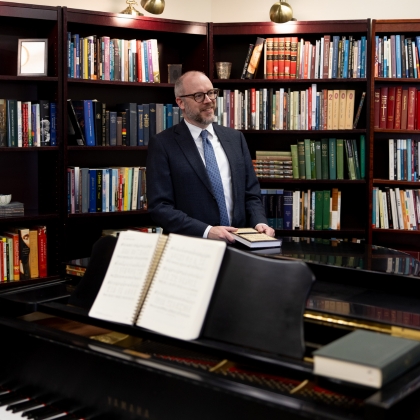
That gap between an unrehearsed congregation and a coherent, gospel-shaped worship service is where Matthew Westerholm, professor and Chair of Biblical Worship at Southern Seminary, has spent his career. It’s also the gap Southern and Boyce College train worship leaders to fill.
Worship musicians practice their tempos, their keys, their arrangements, not to impress a congregation but to carry it in biblical worship. This means skill and theology serve as two sides of the same coin in directing worship to the lordship of Christ.
“We rehearse so that the congregation doesn’t have to,” Westerholm said. “They walk in, the music starts, they know when to enter, and they can just enter in and sing. And the goal of gospel-shaped worship is that they walk out not saying what a great worship pastor or what a fantastic band we have, but what a fantastic Savior we have.”
Westerholm likes to describe a worship leader the way John the Baptist described himself: not the bridegroom, but the friend of the bridegroom. The job is to get out of the way so two other parties can meet.
“We are here to enable this connection to happen between Christ and his church,” Westerholm said. “If we get in the way, we are out of line.”
Biblical worship is a conviction that shapes everything about how Southern trains worship leaders, and it’s why Southern Seminary and Boyce College have spent the past year adding new faculty members: Zack Stanton at Boyce and Trevor Coleman at the seminary.
At Boyce, Stanton joins Kha Do, who has taught since 2019 and whose Master of Divinity and PhD in Christian worship gave the undergraduate program a foundation formed more by the church than the concert hall. Stanton holds a Doctor of Musical Arts in Composition from the University of Texas at Austin and taught music theory and composition at the University of Iowa for eight years. He most recently served as Worship Director at Grace Community Church in North Liberty, Iowa. Westerholm sees the two men’s gifts as complementary rather than overlapping.
“Dr. Stanton comes with the highest musical background and training, whereas Dr. Do comes with a robust ministry background,” Westerholm said. “Dr. Stanton is going to help train our undergraduates in musical skills, even if students do not enter college with previous musical studies. And Dr. Do is just world class at forging college students into excellent musical groups.”
At the seminary level, Trevor Coleman joins the Department of Biblical Worship as Assistant Professor of Church Music and Worship, after several years directing the Doxology Vocal Ensemble and serving as Worship Pastor at Hurstbourne Baptist Church. His doctoral work centers on something worship curriculum often underemphasizes: leadership.
“Worship leaders are leaders,” Westerholm said. “Most of our classes are on worship and not on leadership. A big chunk of Coleman’s doctoral work is on institutional and organizational leadership, and how worship leaders can help with that.”
Coleman urges worship musicians to recognize their stewardship of leading the whole congregation.
“Worship leadership goes beyond what happens on the platform,” Coleman said. “Leaders must learn to navigate the complexities of worship ministry with wisdom and love, prioritizing the care of their people and their love for Christ while they lead.”
Southern Seminary’s conviction about what a worship service actually is shapes the hiring of faculty and the type of leaders who graduate and go on to serve the people of God.
“Worship isn’t an elective in church the way a men’s breakfast or a Tuesday Bible study is,” Westerholm said. “Everyone attends. To the degree the worship service helps people celebrate the gospel and grow in their faith, it blesses the entire church, not just a portion of it. The only other ministry like it is the preaching ministry.”
Westerholm resists handing his students a formula for worship because each congregation across the nation and the globe harbors a unique context but the same Christ.
“We are not sending the worship leaders we train out with a list of songs their church should be singing,” Westerholm said. “We are trying to fill them with the sixty-six books of the Bible, so they can meet their people with a heart of love and a heart of knowledge of God’s Word. Then they can choose songs that will be best for that church. Baptists don’t answer to a bishop in Rome or a seminary professor in Louisville. They answer to the Lord Jesus.”
Southern Seminary and Boyce College have the faculty to send more students out. What they’ll carry with them isn’t a playlist or a performance style. The biblical worship program exists to equip worship leaders with the same instinct Westerholm has been forming in himself for years: rehearse hard, then disappear. On Sunday morning, a church that has never practiced can walk in and worship a Savior they have known, and been known by, their whole lives.