
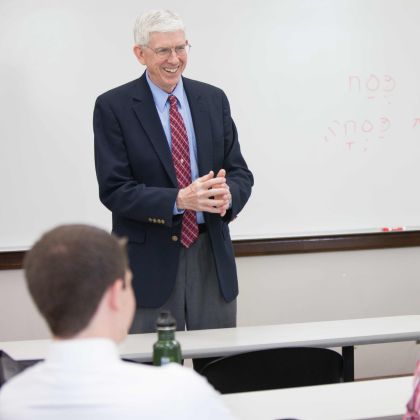
Tom Nettles has spent decades steeped in Baptist history, and even now, as he faces health challenges, his devotion to the Baptist story has not dimmed. Though he could not attend the John Gill and Nicaea Conference held at Southern Seminary on October 31, his influence was felt in the room.
Jake Stone, PhD student and Baptist historian, read Nettles’s paper on John Gill on his behalf, allowing Nettles’s scholarship to contribute even in his physical absence. For those who knew Nettles, this felt fitting. His work has shaped a generation, and his commitment persists even through hardship.
Nettles first encountered Baptist history in a roundabout way. He had studied Anabaptist history in both his M.Div. and PhD programs. But those early encounters cultivated what became a lifelong pursuit. That initial spark soon grew into a sustained curiosity. Nettles became increasingly interested in confessional history and the theological distinctions that shaped Baptist identity. One moment in a seminary classroom played a key role.
“A systematic theology professor divided each theological heading into ‘Old view,’ ‘liberal view,’ and ‘class view,’” Nettles said. “He listed Southern’s founder James P. Boyce and John Dagg, the first Baptist to write a systematic theology, under ‘old view.’ I began to read them and was riveted to the scriptural foundation, their reasoning, their conclusions, and their synthesis.”
These older and often overlooked Baptist theologians became central figures in Nettles’s theological development. Meanwhile, discussions with peers pushed him deeper into questions of revelation and authority.
“Discussions with beloved peers at SWBTS focused on issues of biblical inspiration, the disputed issue of inerrancy, and the issue of the historic Baptist view of these issues,” Nettles said. “These conversations eventually bore fruit. Eventually, these discussions led Russ Bush and me to write Baptists and the Bible.”
But it was the classroom, semester after semester, that cemented his lifelong devotion. Beginning in January 1976, Nettles taught Baptist History regularly, and the routine shaped him in a profound way.
“The semester by semester teaching of Baptist History beginning in January 1976 required expansion of reading in primary sources and increased my appreciation of and conscientious devotion to the Baptist story and doctrine,” he said.
That devotion continued to the present. Nettles still writes and speaks on figures like John Gill, because of the formative power of historical witnesses.
“The figures of Baptist history help shape our minds, our hearts, our doctrine, our convictions, and our resolution to endure to the end,” Nettles said.
He speaks with special admiration for Baptists like Andrew Fuller and William Carey.
“Their partnership demonstrated that ‘the fellowship of kindred mind’ under the power of the word and the passion for God’s glory in the gospel can transform virtually the whole of Protestant Christianity in the English-speaking world,” Nettles said. “These figures can enflame our zeal to insist on the truth we know and yearn for growth in the grasp of biblical truth.”
Nettles also remains committed to recovering neglected or misunderstood figures, none more so than John Gill. Nettles lamented that historians’ “misjudgments” sometimes shaped thought in a twisted way that hid treasure from subsequent generations.
“A dismissive classification of Gill has done considerable damage,” Nettles said. “By dismissing Gill as a hyper-Calvinist, that label left massive amounts of doctrinal, exegetical, and polemical material gathering dust.”
For Nettles, the remedy is simple but demanding. Study the sources.
“Spending time with Gill’s commentaries and systematic theology—and his various treatises—can enrich one’s soul and sharpen one’s ability to preach and interact ‘For the Cause of God and Truth,’” Nettles said.
Nettles’s enduring impact on Baptist studies was felt by those who attended the conference. Zach Williams, a Baptist historian who completed his PhD at Southern Seminary and traveled from Mississippi to attend the event, described what the gathering meant to him.
“Now that I have moved away from Louisville, I am always looking for ways to stay connected with friends and former colleagues at SBTS,” Williams said. “The recent conference on John Gill and Nicaea, organized by The Andrew Fuller Center and the London Lyceum, was a perfect opportunity to do just that.”
Reflecting on Nettles’s contribution, Williams added, “I was especially thankful for the contribution of Tom Nettles, who took the time to write an excellent paper for the conference despite being in a season of significant personal hardship. Dr. Nettles is nothing short of a legend in Baptist studies, but more importantly, he is a model of Christian virtue and humility. I pray that the Lord will bless his labors for many more years to come.”
For Nettles, the rising generation of historians represented at that conference offered real hope. His advice is clear: remain committed to the clarity of Scripture and the lessons of history.
“I am heartened with the level of piety, doctrinal acumen, and scholarly discipline that I see in this emerging generation,” Nettles said. “Let your research and evaluations be governed by a commitment to the clarity, integrity, and finality of divine revelation. Tell the truth. Defend the faith.”
Even in a season of hardship, unable to attend in person, Nettles continued to do just that. And in settings like the October 31 conference, his influence still stands.